
Uncategorized

Applied Architecture patterns on the Microsoft platform geographic spread

 IMG_2292

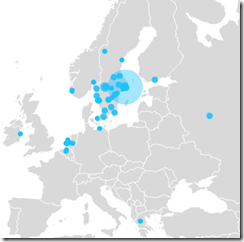
BizTalk User Group Sweden organized an event the 8-9 of September that was marketing branded as the European BizTalk Conference and featured no more than 2 US BizTalk MVPs and a member of the SQL Server CAT Team. Richard Seroter, Stephen W. Thomas and Ewan Fairweather. They delivered an impressing 13 session over the course of two days featuring content from the new book they co-authored – Applied Architecture Patterns on the Microsoft Platform (Sample chapter is here). A crowd of roughly 150 people from an amazing 13 countries (among them around 10 MVPs) listened attentively as they delivered patterns, technical insight and lessons learned on topics such as BizTalk Server, Windows Server AppFabric, Windows Azure and SSIS. To top it off the whole thing was recorded and will be made available through MSDN. People walked away happy, wearing nice giveaway polo shirts. A gang of three was even more lucky as they were picked as the winners for a MSDN Ultimate subscription giveaway. Did I mention it was free?! Url of event is here: http://bugs20100908.eventbrite.com/

UPDATE: Presentation material from the event is here (this leads to BizTalk User Group Swedens main site, look in the bottom right corner). I will update again with URL of recordings once they are available.

Map is courtesy of Eventbrite, which really is a wonderful service, especially if you are a non-profit organization like a user group.
image

Uncategorized

Amazon plays it safe or "How RESTful.NET traveled to Sweden in 8 days"

We ordered Jon Flanders new RESTful.NET book from Amazon US. It was a tough choice. The local supplier had it on their site, but stated that it would take 26-40 business days to deliver. Amazon UK was slightly better, but not by much since at the time they didn’t have the book marked as in stock either. And with the shipping options and cost if was more expensive by a more than slim margin. Amazon US was second best priced, if anything Bokus has really good prices. But in this case that was worth nothing when they couldn’t deliver. The shipping options to Europe aren’t great at Amazon. Expedited international shipping costs $18 and was said to arrive in 8-19 days. Even though they had the book marked as in stock at the site the first order confirmation I got informed me that the book would be shipped 8 days after I placed the order with an estimate arrival of December 24th. The actual time it took before it shipped was 4 days, according to my second confirmation. This time I got an estimated arrival of December 31st.

But here I am, it’s December 11th and I’ve got it in my hand. Amazon plays it safe.
I’m all for that; better to get a good surprise than a bad one. But I feel they are in risk of loosing customers with that approach. But then again, the customers they do have will be happy customers.

However, with that said. At this point in time, a couple of weeks later than we ordered, I highly recommend you to get this book from Bokus if you are a Swedish resident, since they now have it for delivery in 5-8 days. Cheaper than Amazon, and without the cost of shipping it from the US.

Now I’m looking forward to get some reading done.

Uncategorized

PDC Wireless Tip

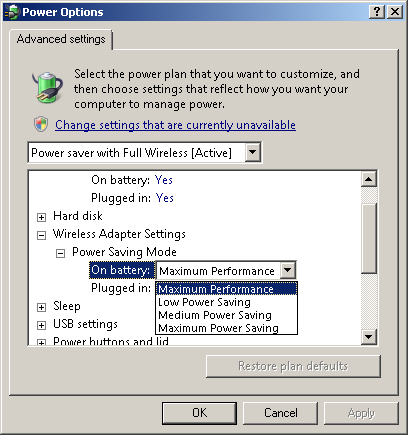
I’ve heard alot of people, and helped a few, that have had problems with the PDC Wireless network. The things that many people do at conferences is to sit with their laptop in their knee. Doing this they are not plugged in. When your laptop goes into it’s Power Saving mode, it lowers the performance on your wireless adapter. This in effect can, and will often, result in your computer having problems reaching the wireless network. You can however change this, and run the wirless on full power while still having all other settings set for power saving. If you go to Power Options –  Change plan settings – Change Advanced Power Settings, you get the window in the picture. Now if you scroll down a bit on that you’ll find your wireless, and unless you change this it will have the Maximum Power saving option. Change this to Maximum Performance instead, and of you go!

image

Uncategorized

A BizTalk Developers approach to Oslo

So you’ve probably heard of this thing called Oslo and the components of it. In this post I’ll try to address Oslo from the point of view of the BizTalk Developer.

You could argue that BizTalk has a pretty model driven approach to development, although you’d be hard pressed if you went as far as calling it model first, or even schema first. The concepts of developing and deploying an Oslo model does however closely resemble the order of the steps performed to develop and deploy a schema in BizTalk.

First of you develop a schema, a xsd, or in Oslo terms a model. You do this in the tool called IntelliPad, using the language called M. Another way to put this is that M lets you define a textual DSL.

Second you compile, or validate, this schema. In Oslo terms you convert it into an image. You (currently) do this using the Oslo command line tools, the Oslo compiler.

Third you import this schema into the repository, like you would a BizTalk schema into the MgmtDb. In Oslo this step converts the model into SQL code. Oslo is very tightly coupled to SQL, and the repository is really just a database. A quote I caught is that “M is to T-SQL as C is to assembly”.

You can then build a xml document that conforms to that schema. You would to this in what would equivalently be an infoset. In Oslo this is again done using the IntelliPad tool and still using the M language. Now you can compile this document, which performs schema validation, after which you can put this data into the repository – that is (for the sake of the BizTalk comparison) you can receive an xml document resembling the desired schema and disassemble it into the internal format, in this case a SQL table.

Now if you want to enter data in a format other then xml, perhaps a flatfile, you can do this. In this case you would then disassemble that format (although there is no real equivalent in Oslo for this step) and then use a map (xslt) to transform this document into the correct xml format according to the specified schema. In Oslo terms this is what is called a grammar. A grammar converts an arbitrary unicode character string into a structural format, ie xml. A grammar again is a DSL, but for a different domain, in this case a domain where you enter things in plaintext.

Now if you want to view this data in SQL in a format other then it’s raw tables, then you can use the Quadrant tool to view this data using any of a generic set of views. These views are Visual DSLs over the same data. There is really no good comparison to this for BizTalk.

You can get Oslo now if you wan’t to play around and see how this looks.